
The Square
Every Italian city has its salotto — its parlor. Vicenza's is Piazza dei Signori, laid over the Roman forum and still doing the forum's job: market twice a week, passeggiata every evening, spritz o'clock at six.
Ring the square with your eyes and you read the city's whole history: the medieval Torre Bissara; Palladio's white Basilica along one flank and his unfinished, richly sculpted Loggia del Capitaniato (1571) facing it; the long frescoed front of the Monte di Pietà; and at the east end two Venetian columns carrying the winged Lion of St. Mark and the Redeemer — Venice's calling cards, planted here when Vicenza joined the Republic.
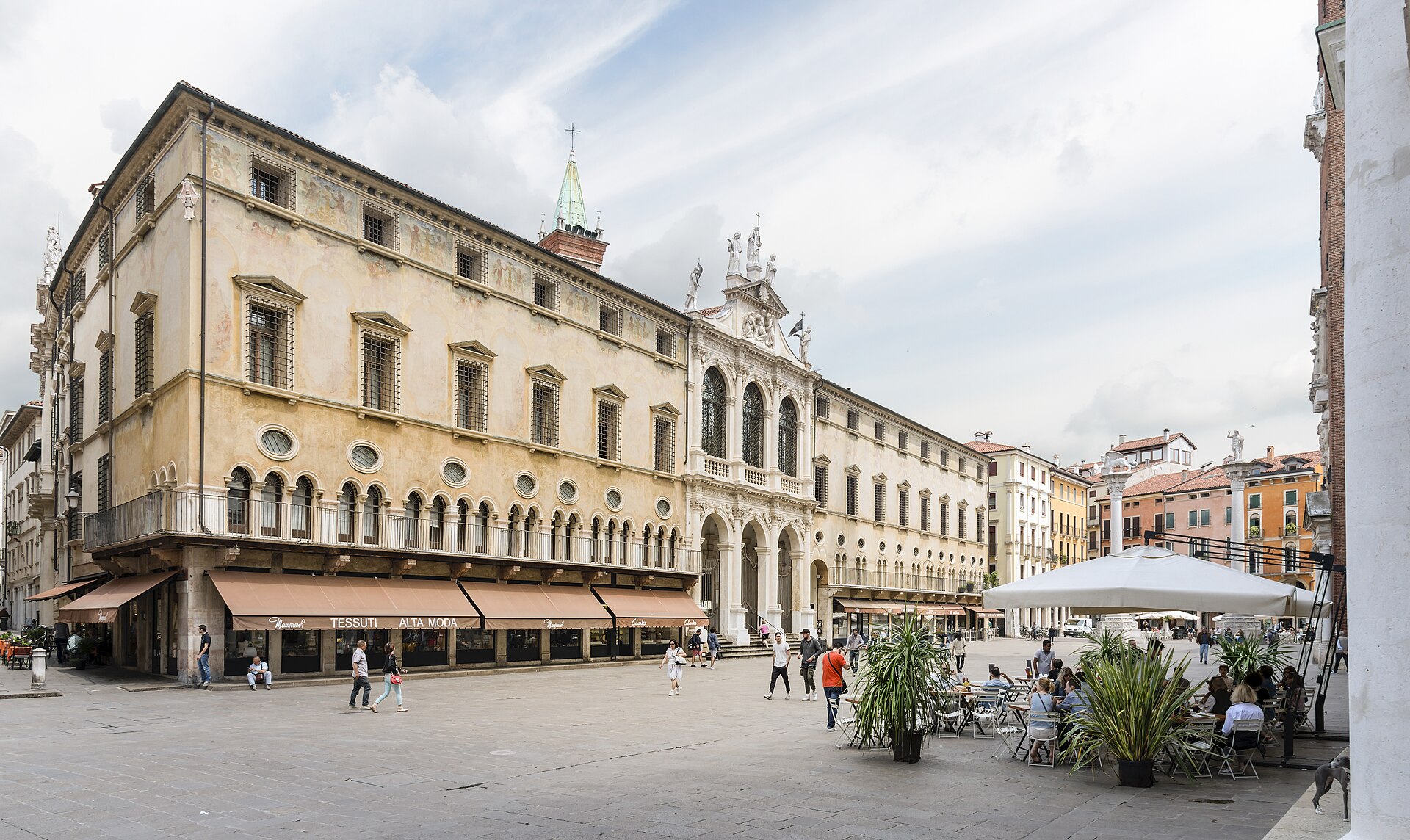
- Market days: Tuesday and Thursday mornings the piazza and surrounding streets fill with stalls — the liveliest time to see it (Shopping).
- Aperitivo: from about 18:00 the café terraces along the Basilica fill up. You pay a small view premium here; worth it at least once (Food & Drink).
- Around the corners: Piazza delle Erbe behind the Basilica (bars, osterie) and Piazza delle Biade at the east end, with the Gothic church of Santa Maria dei Servi.
The Basilica Palladiana
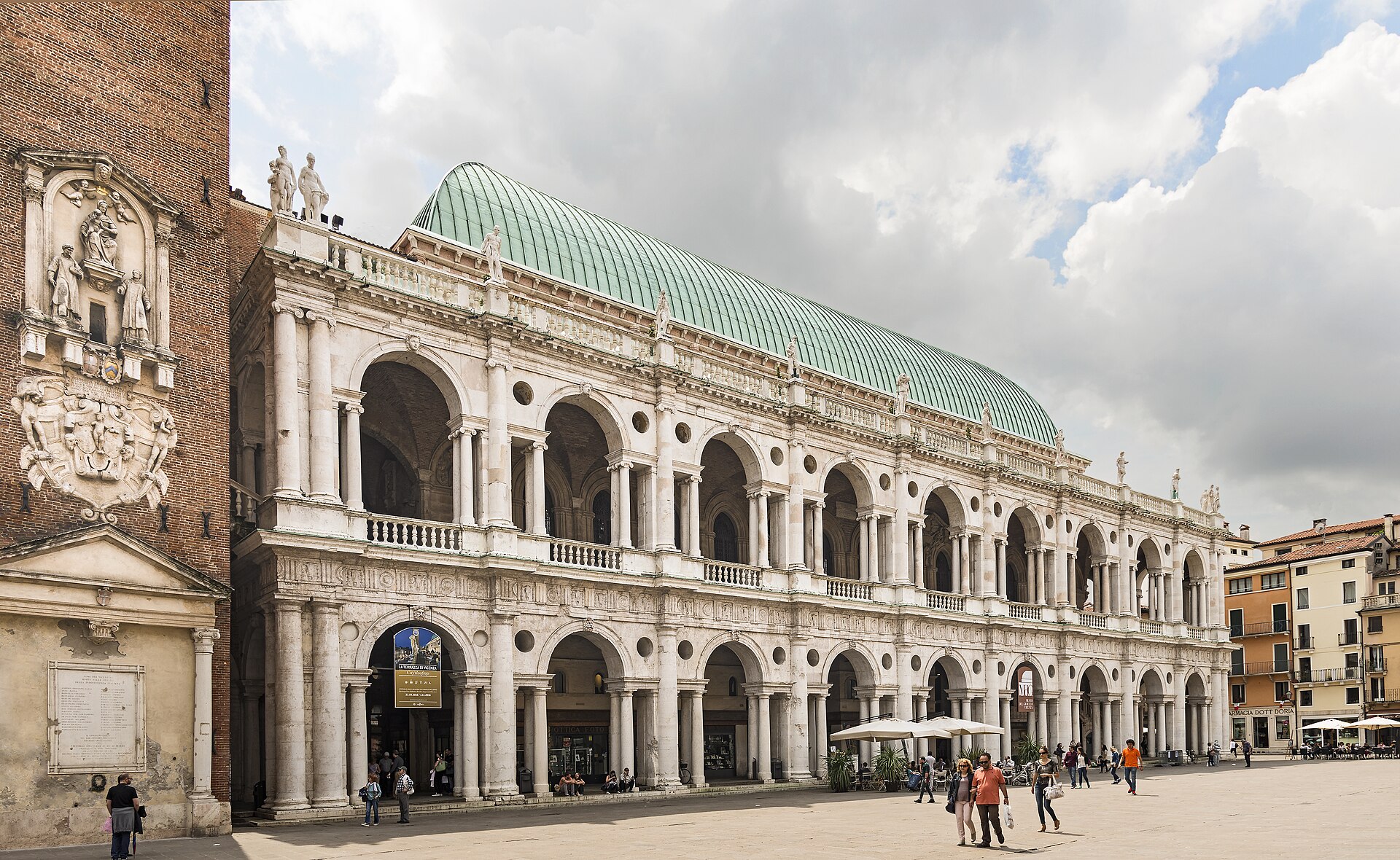
Not a church: in the Roman sense a basilica was a hall of justice and civic business, and that is what the Gothic Palazzo della Ragione (15th century) beneath the marble skin has always been. When its earlier loggias collapsed, the city ran a fifty-year competition that drew the biggest names in Italian architecture. In 1549 the commission went — against the odds — to the young local stonemason Andrea Palladio.
His solution made his name: wrap the old hall in a two-story loggia of gleaming white Istrian stone, using the endlessly flexible arch-between-columns motif now known worldwide as the serliana or "Palladian window," whose variable side openings quietly absorb the medieval building's irregular bays. Work finished in 1614, long after his death. The great copper roof, shaped like an upturned ship's hull, burned after Allied bombing in 1945 and was faithfully rebuilt.
- Inside: the vast upper hall — one of Europe's great civic rooms — hosts major art and design exhibitions; opening depends on what's on.
- The rooftop terrace opens seasonally (typically warm-season evenings and during exhibitions) for drinks and skyline views between the statues — the single best sunset spot in the city. Ask at the tourist office or check the city's site for the current season.
- Ground floor: the arcades shelter historic goldsmiths' shops — Vicenza's signature trade since the Middle Ages — plus cafés (the city of gold).
- UNESCO: the Basilica is a headline monument of the World Heritage listing; Palladio himself boasted it could stand comparison with any building of antiquity.
Torre Bissara
The slender bell tower beside the Basilica reached its full 82 meters in the 15th century, making it the tallest structure in the historic center. Its bells still ring the hours twice over — a Vicenza quirk — and its clock once showed phases of the moon. The tower occasionally opens for guided climbs during special events; the view over the piazza is superb if you catch one.
Practical
The piazza is two minutes from Corso Palladio and ten minutes' flat walk from the train station. Exhibitions in the Basilica are ticketed separately; the tourist office at Piazza Matteotti (by the Teatro Olimpico) has current hours for everything on this page.