
Why Go
If you make one trip into Vicenza's province, make it this one. Bassano has everything the big cities have — art, arcaded squares, serious food and drink — compressed into a walkable riverfront town with the Alps standing straight up behind it.
The town sits where the Brenta river leaves the mountains through the Valsugana gorge. That geography made it a trading crossroads, a WWI front-line city, and the keeper of two icons: the covered wooden bridge and the distilleries beside it.
The Ponte degli Alpini
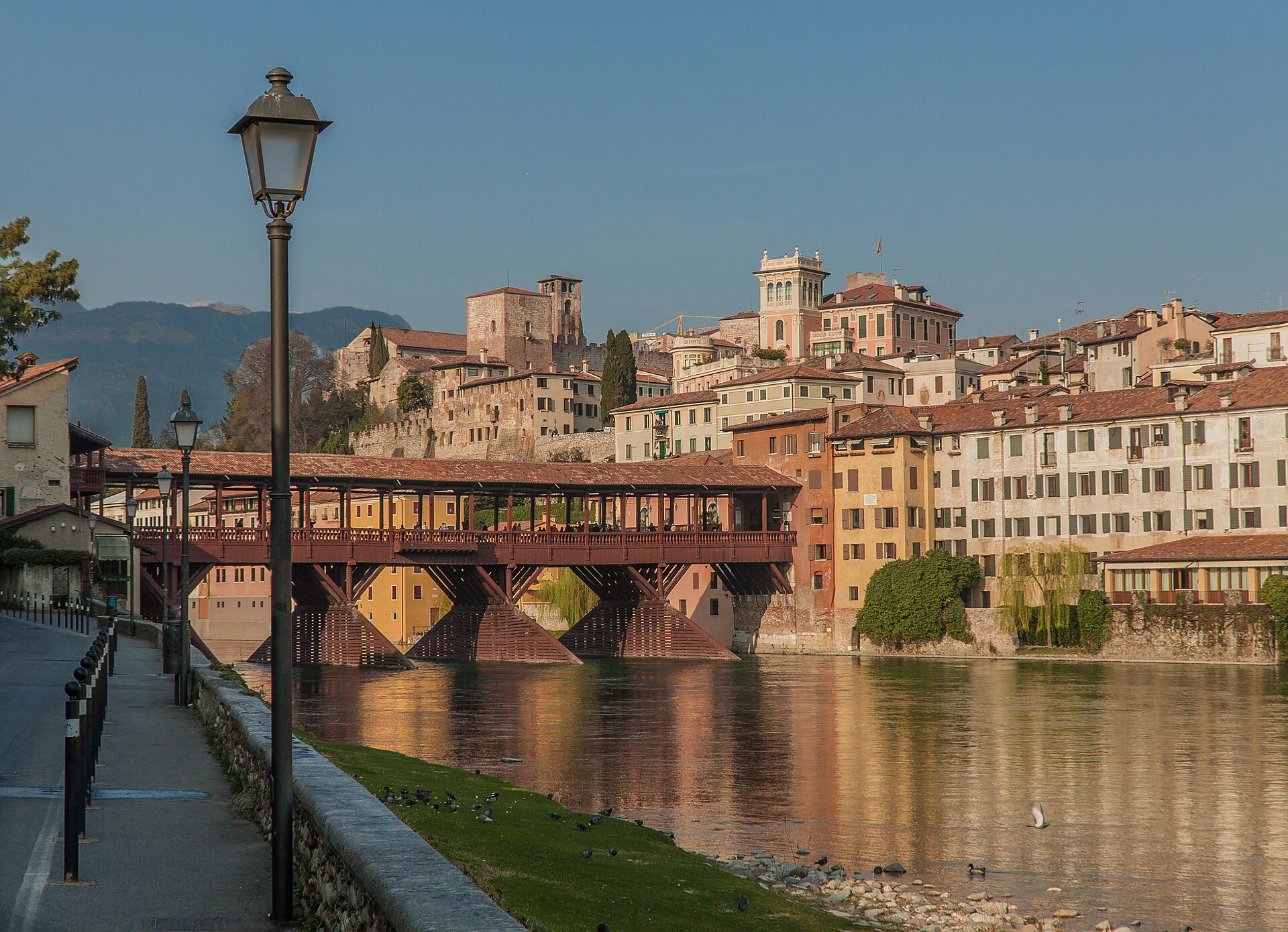
A wooden bridge has crossed the Brenta here since the 13th century. After a flood destroyed it, the town asked Palladio for a replacement; his elegant covered truss design of 1569 has been the template ever since. Floods and wars have taken the bridge down repeatedly — most recently in 1945, when it was blown up during the war — and each time it has been rebuilt exactly to Palladio's drawings, the last full restoration finishing in 2021.
Its name honors the Alpini, Italy's mountain troops, who rebuilt it in 1948 and whose association keeps a small museum at the bridge's east end. Walk it at golden hour, when the Brenta runs green below and the Grappa massif glows pink upstream — one of northern Italy's great views.
Grappa, Obviously
- Nardini, in business at the bridge since 1779, is Italy's oldest distillery — stand at the worn wooden bar of the Grapperia on the bridge itself and order a mezzo e mezzo, the house aperitif of Nardini rabarbaro, Cynar, and soda.
- Poli, across the street, runs a free, genuinely good Grappa Museum with tastings.
- Despite the name, the town isn't named for the drink — both take their name from Monte Grappa, the mountain above. The grappa connection is simply four centuries of distilling tradition on this spot.
Beyond the Bridge
Piazza Garibaldi & Piazza Libertà
The twin main squares: the civic tower, Venetian lion, arcades, and the Museo Civico with works by Jacopo Bassano, the town's Renaissance master.
WWI: the White War's Doorstep
Monte Grappa above town was the last-stand front after Caporetto in 1917. The Viale dei Martiri remembers partisans of WWII; drivable in summer, the summit's vast Sacrario ossuary holds 22,000 fallen and a 360° view of the plain and Alps.
Ceramics
Bassano and neighboring Nove have made maiolica since the 1600s. The Palazzo Sturm ceramics museum overlooks the river; workshops in Nove sell direct (Shopping).
White Asparagus in Spring
April–May is the season of Bassano's DOP white asparagus, eaten with chopped-egg sauce in every trattoria — plan a spring lunch around it (Food & Drink).
Marostica, 15 Minutes Away
The walled town with the giant chess board in its piazza — a living chess game is played there with human pieces in September of even years. Two castles, one hillside of olive trees, and cherries in June (Events).
The Brenta Valley
North of town, the Valsugana cycle path follows the river toward Trento — rent a bike for a flat, scenic ride; or visit the Oliero caves and the hydro-carved gorge at Valstagna.
Getting There & Making a Day of It
- Morning train from Vicenza (direct regional line); coffee under the arcades of Piazza Libertà.
- Museo Civico or Palazzo Sturm, then the bridge and the Alpini museum.
- Lunch by the river — asparagus in spring, baccalà and polenta year-round.
- Mezzo e mezzo at Nardini, Poli's grappa museum across the street.
- Bus or taxi to Marostica for the chess square and ramparts, or the evening train home.